
discoveries
2 min readKindle adds a font that makes letters stand apart.
See the design detail behind a newly added reading option without presenting a font as a universal solution.
Amazon's November 18 update to its Kindle accessibility article adds a small but revealing reading option: Atkinson Hyperlegible. The news is its rollout for Kindle, rather than the invention of a new typeface. Braille Institute dates the original to 2019 and its expanded Next version to 2025.
The design starts with characters that can be confused. A capital I, lowercase l and the numeral 1 can look similar, particularly at small sizes or for readers with low vision. Braille Institute describes clear uprights, open counters and differentiated letter pairs as features of the family. In other words, the characters do not have to share as much visual shape simply because they belong together.
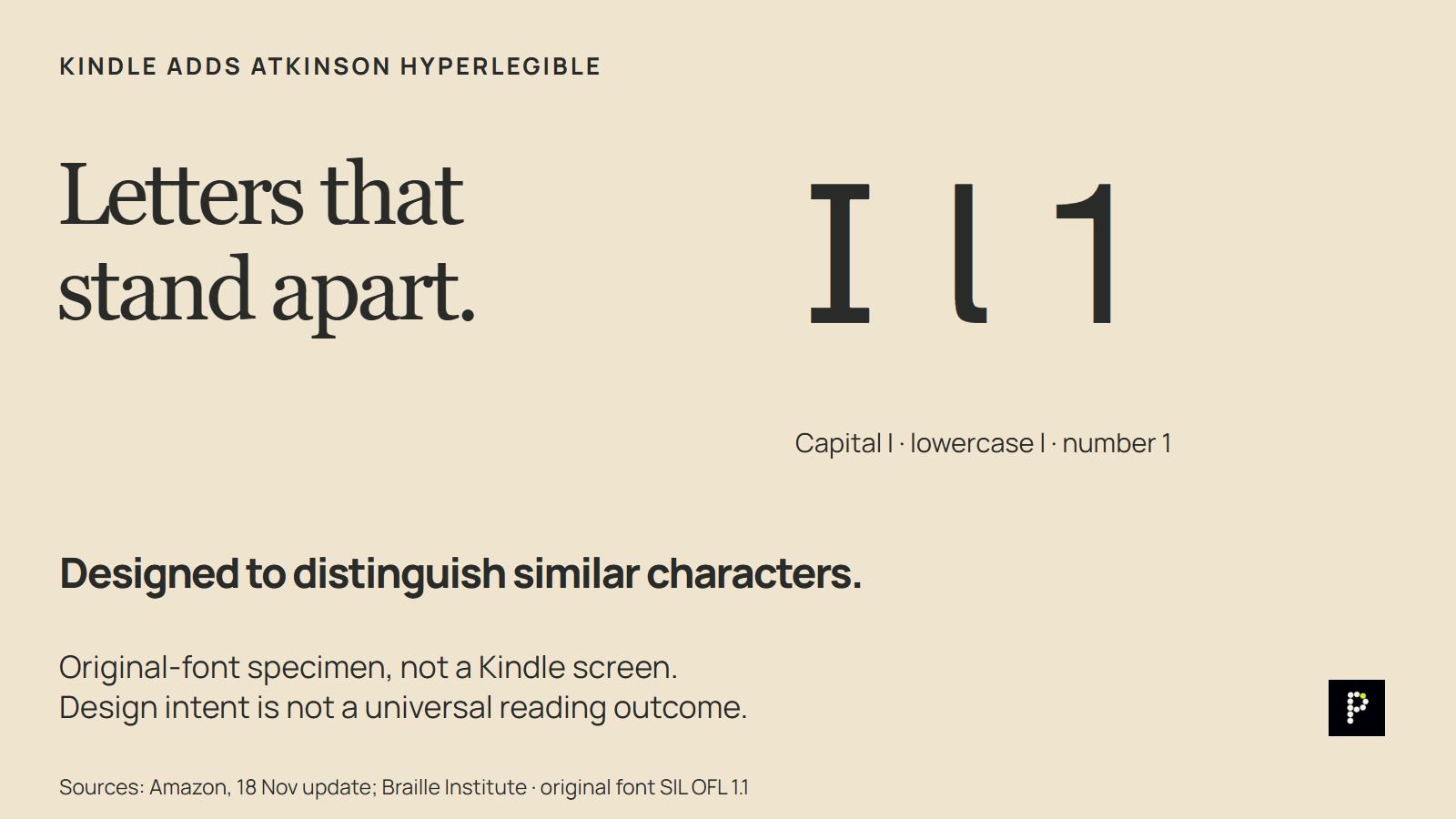
Image: Point & Pattern. Original Atkinson Hyperlegible font: Braille Institute of America, SIL Open Font License 1.1 via Google Fonts.
Our artwork uses an actual licensed copy of the original Atkinson Hyperlegible Regular font to show the letterforms. It is a font specimen, not a screenshot of a Kindle interface and not verification of the exact font version installed on a device. The specimen uses the original Regular font, distributed under the SIL Open Font License 1.1.
Amazon's article also describes adjustable text sizes, margins and spacing. That is the useful practical context: readability is a set of choices, and the best combination can differ between readers and books. A font designed for greater distinction does not establish faster reading, improved comprehension or a universal outcome for every disability. We have not conducted a reader study or device test.
For designers, the discovery is a concrete principle to inspect: notice which characters need to remain different. For readers, check whether the option appears in the Kindle product you use and compare it with the settings that already work for you. The announcement establishes a rollout, rather than availability on every device at once.